Why Duplicate Bidder Numbers Break Checkout
You are at the settlement table with a stack of bid sheets, and two of them carry the number 014. One belongs to a parent who arrived at 5:40, the other to a grandparent who signed in ten minutes later. Nobody wrote down who received which card, so the totals cannot be matched to a person. The auction is over, but the paperwork is not.
This usually happens because numbers are handed out at the door in arrival order, written on whatever card is nearby, with no single list that ties a number to a name. Once two people hold the same number, every bid sheet with that number becomes ambiguous. This article shows how to assign bidder numbers from a registration log so each number belongs to exactly one person before any bid sheet is issued.
Set Up the Registration Log First
The log is the source of truth, not the number card. Before the doors open, prepare a sheet with these columns: bidder number, name, phone, time issued, deposit or payment method, and a notes column for settlement. Keep it at the check-in table, and treat the number card as a copy of the log entry, not a replacement for it.
Decide the number range in advance. If you expect 120 guests, print cards 001 through 150 so you never run out mid-line. Pre-printing the cards also removes the temptation to scribble a number on a blank card when the line gets long.
Assign Numbers in Three Steps
1. Register before issuing
Ask for name and phone, write them on the next open line, then hand over the matching card. The bidder should not receive a number until the log row exists.
2. Check for duplicates at the moment of issue
Before writing a number, scan the log for it. If 014 already appears, take the next unused number and note the correction. Never overwrite an existing row to reuse a number; a reused number reopens the exact ambiguity you are trying to close.
3. Keep the log open until settlement ends
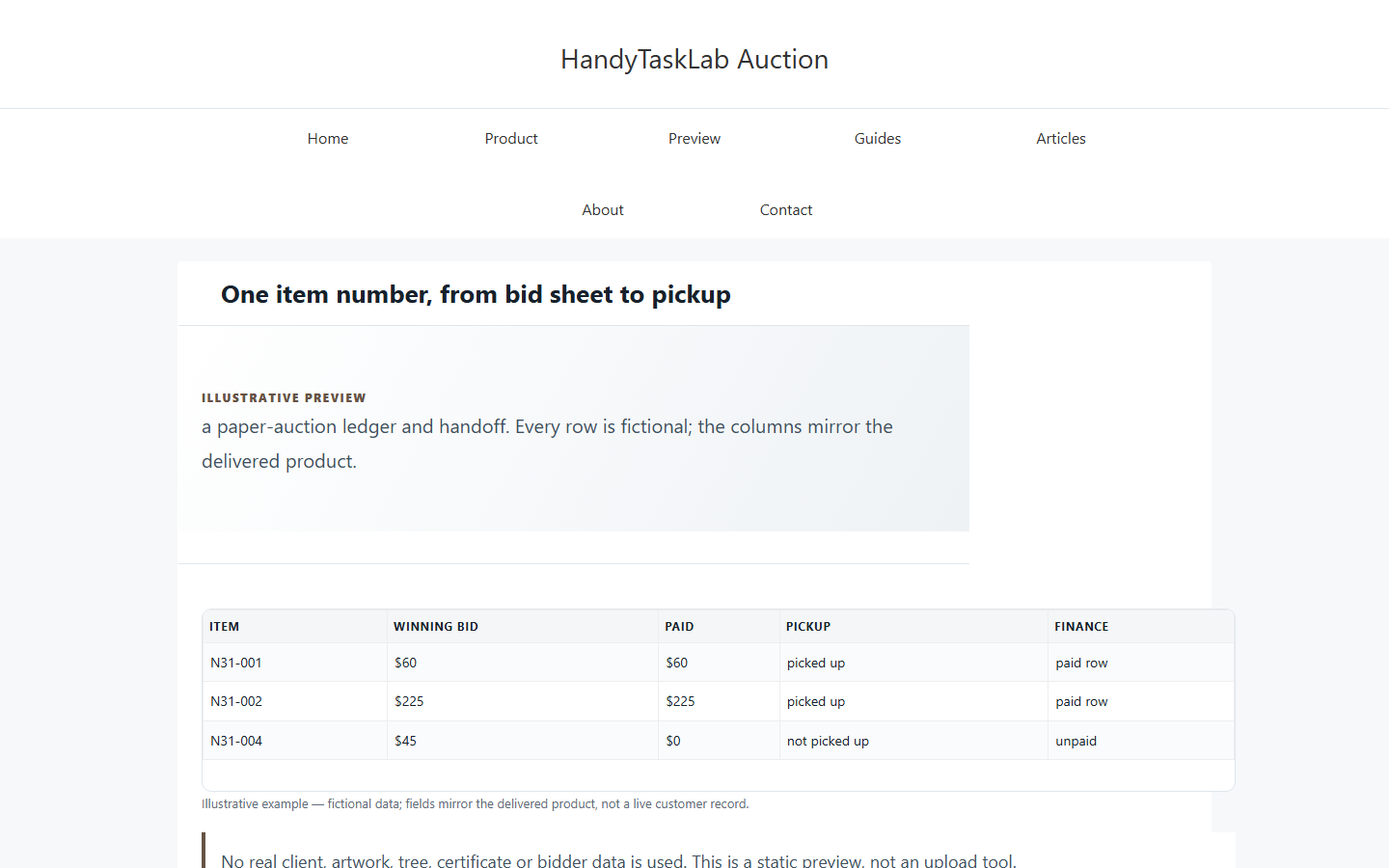
During checkout, mark each row as paid, picked up, or pending. The log then doubles as the handoff record for whoever reconciles the money.
A Short Fictional Example
Bidder A registers and receives 014. Bidder B arrives later; the volunteer reaches for 014 again but sees it on the log, so B gets 015. At settlement, the sheet marked 014 traces to A and 015 to B. If a guest loses a card, the log still shows which number was issued to whom, so the replacement card can carry the same number without creating a second owner.
Verify Before You Close the Table
Run a quick check: every number on the log appears once, every bid sheet number appears on the log, and every log row has a settlement status. If a bid sheet number is missing from the log, flag it rather than guessing the owner. The bid sheet fields themselves are covered in the guide to paper silent auction bid sheet fields, but the number on that sheet is only useful if the log can name its owner.
Common Mistakes to Avoid
- Handing out cards before writing the log row.
- Reusing a number after a guest leaves or a card is lost.
- Letting two volunteers issue numbers from separate stacks without one shared log.
- Closing the log before all bid sheets are settled.
If your team also needs to separate payment from pickup, keep those statuses distinct on the log rather than folding them into one checkmark. A one-time USD 19 printable paper auction pack can supply the registration and bid sheet templates, but it does not process payments or run an online auction; the log and the reconciliation stay in your hands.
Comments